Fraud Blocker
Summer Sale is on! Up to 25% off trips! ā˜€ļø
Machu Picchu, Peru

Peru Travel Guide

Ancient wonders and breathtaking landscapes await travellers in Peru. Explore the awe-inspiring ruins of Machu Picchu, perched high in the Andes Mountains, and witness the remnants of the Inca civilization. Immerse yourself in the vibrant markets of Cusco, where traditional crafts and local delicacies abound. Trek through the mesmerizing landscapes of the Sacred Valley, surrounded by snow-capped peaks and terraced fields. Peru's colonial cities, like Lima and Arequipa, offer a fusion of history, architecture, and gastronomy that will captivate your senses.

One of the highlights of travelling in Peru is the chance to discover the incredible biodiversity of the Amazon Rainforest. Embark on an adventure deep into the jungle, where you can spot colourful birds, playful monkeys, and vibrant flora. Savour the flavours of Peruvian cuisine, from the famous ceviche to the hearty lomo saltado. Immerse yourself in the local culture, participating in traditional ceremonies and witnessing vibrant festivals. Peru's rich history, natural wonders, and warm hospitality create an unforgettable travel experience that will leave you in awe of this remarkable country.

Peru Highlights

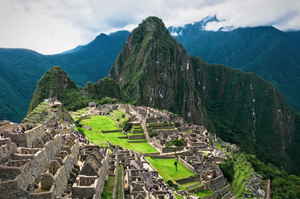
Maze of ancient stone ruins on emerald hills with towering green mountains and blue skies

Machu Picchu

If you are searching for the adventure of a lifetime, you will find it at Machu Picchu. Named one of the Seven Wonders of the World for a reason, these awe-inspiring stone ruins are nestled high into the Sacred Valley peaks. Immerse yourself in the Inca history on our Peru tours - especially if you hike the iconic Inca Trail!

Spider outline on dark sand in Peruvian desert, Nazca Lines

Nazca Lines

One of Earth’s greatest mysteries are the Nazca lines: ancient geoglyph shapes resembling animals and plants, carved into the Peruvian desert. Although scientists estimate the Nazca lines to be over 2,000 years old, no one really knows for sure… Is it a sign of alien life? Either way, this archaeological site is sure to take your breath away.

Person walking down cobblestone alleyway with colourful murals with village in valleys ahead, Cusco

Cusco

Let Cusco cast its spell on you. More than a gateway to the legendary ruins of Machu Picchu, Cusco is one of the oldest cities in the entire world. From the traditional markets selling colourful handicrafts to the ancient archaeological sites and charming cobblestone laneways, this bewitching destination draws you in right away.

Candy coloured striped rainbow mountains on a sunny day with some white clouds

Rainbow Mountains

Chase out adventure while uncovering Peru’s famous candy-coloured hills. Get ready for a trekking journey reaching unbelievable heights, rewarding you with views of Peru’s most vibrant natural wonder. Even more visually striking in person, the feeling can be best described as spotting gold at the end of a rainbow.

Valley with rugged brown mountains curving in at both sides, a little river stream in the centre, Colca Canyon

Colca Canyon

Twice as deep as the Grand Canyon, Peru’s own Colca Canyon is packed with moments that will take your breath away. The wildlife alone is extraordinary, from the Andean condors soaring through the sky to the adorable alpacas and llamas. As you hike to the top, jade green valleys transform into rocky mountains and rugged cliff edges.

Modern city with green hills and road right by the coast, with paragliders flying through the blue sky

Lima

Lose yourself in the wanderlust of Lima, Peru’s coastal capital. From its surfer beaches to the world-famous food scene and incredible street art, this city is a feast for the senses. When you are not exploring all the boho chic boutiques, get a taste of traditional culture by signing yourself up for a cooking class.

Person in black clothing carrying a sled and walking over golden dunes in the desert at sunset, Huacachina

Huacachina

Who knew that Peru could even look like this? Between the golden sand dunes that glow under the sunset, the sweeping palm trees and the glistening emerald lagoon, Huacachina is the dreamiest oasis you could imagine. The best way to take all this beauty in on our Peru tours is by sandboarding - get ready for an adrenaline rush!

Bright green valley with terraced ruin hills surrounded by green mountaisn and a little village at the bottom with blue skies

Sacred Valley

As part of your journey to Machu Picchu, step inside the Sacred Valley and prepare to be amazed. Picture this… Misty, frozen mountain peaks that lead into rolling hills of evergreen. Hilltop temples and labyrinths of ruins everywhere your head turns. Colourful markets inside rural villages. Welcome to the heart of the Incas.

Traditional corridor with columns overlooking cobblestone street and classical white church with clear blue skies, Arequipa

Arequipa

Arequipa is easily one of the most enchanting cities in the Americas, from its ring of volcanoes to the picturesque architecture carved from white stone. Peel back its endless layers on our Peru trips. Whether you feel like unwinding at a cosy cafe, diving deep into the local history or hiking the historic Sillar Route, Arequipa has it all.

Traditional Peruvian boat sailing across Lake Titicaca's indigo blue lake surrounded by valleys on a cloudy day

Lake Titicaca

Stretching across Peru and Bolivia, there is something magical about Lake Titicaca. Believed to be the birthplace of the sun under Inca mythology, expect to find beauty around every corner while sailing across Lake Titicaca. Deep indigo waters lead into secret temples and secluded islands, making a homestay here an absolute must.

Key Facts

Capital City

Lima

Currency

Sol (PEN)

Language

Spanish

Dialling Code

+51

Plug Type

A and C

  • Peru is a mid-size South American country spanning three quite different climate zones: Pacific coastal plains, Andes and foothills, and the Amazon jungle, so there are lots of great things to see.
  • Machu Picchu is the top attraction. The site is home to the remains of an Inca city built as a refuge from the invading Spanish conquistadors, found high up on a mountain, which rises hundreds of metres straight up from the Urubamba River. The ruins are less of a city and more like a village in size, but they are extremely impressive, with ancient stone walls, pyramids and incredible views.
  • The Nazca Lines are another ancient site, but these remain unexplained. They are very long, perfectly straight score lines in the ground, which is mostly solid rock. From the air, they are intriguing, with many different discernable patterns, but from ground level, you can’t make them out, so you really need to take a short flight to see them properly. There are patterns depicting a dog, parrot, monkey and many other familiar things, some of the shapes being over 100 metres long. One is called the Spaceship, and indeed there are suggestions that the long lines were caused by spacecraft landing and that some form of alien species drew the images.
  • Lima is an interesting Spanish colonial city, which has now spread far from its main plaza. In the city, you can visit gold exhibitions and other interesting cultural sites, or head over to the popular beach resort of Miraflores, which is a good place to stay for a few days.
  • Cusco (or Cuzco) is a world heritage site and a ā€˜must’ if you’re in Peru. Tourists flock to the city to visit its many ruins and beautiful colonial buildings. High in the Southern Sierra Mountain Range, Qoricancha, the sun temple, was an important place for Inca worship and boasts some spectacular views. There are many other temples and historic buildings to see and it’s the base for trips to Machu Picchu and the Sacred Valley of The Incas. You can also enjoy a thrilling white water raft on the Urubamba River.
  • Hike the Inca Trail to Machu Picchu. The trip takes four days and you carry what you need, although often there are porters to help you out. It is well worth the effort when you arrive at Machu Picchu in the early morning, ahead of the bus crowds.
  • The Amazon rainforest lies in Peru’s eastern part. It’s a jungle with incredible biodiversity, and the murky Amazon River is more than a kilometre wide here.
  • It’s a great place to learn Spanish.

Peru is the home of the potato, with over 5000 different varieties available! A side of potatoes comes with most dishes, and there is often rice on offer too. Coastal menus favour fresh fish, including Peru’s national dish, ceviche. This is a mixture of seafood with lemon, coriander, chilli and garlic and is a wonderfully fresh and delicious treat. 

In the Andes region, you might sample grilled Alpaca (a small variety of llama) which is a lean meat and a speciality of the region.  If you’re feeling really adventurous you could try a plate of seared guinea pig – although this Peruvian delicacy is not for everyone!

Peruvians love sweet treats and if you’re in Lima you should definitely try the ‘churros’ – a caramel-filled deep-fried doughnut which will give you an amazing sugar rush!

There are three distinct regions in Peru: the Coastal plain, the Andes highlands and the Amazon.

On the arid coastal strip, it is hot and dry from December to March. From April to November it can be misty, as the warmer air from the desert meets cold Humboldt air currents, but is still warm and dry although the sea is very cold.

In the highlands, the winter is dry and cold (May to August) and summer is hot and wet (December to March). In the winter, the temperature can drop down to freezing at night. Top temperatures are in the mid-20s.

It rains all year round in the hot and lush Amazon region. The driest time is June to September. However, even during the wet months, it rarely rains for more than a few hours at a time, although this can be torrential. If you don’t like heat and humidity, avoid the jungle!

Visa Assistance

Visas may be required depending on your nationality, travel plans, and length of stay. Below are the FCDO travel advice for British travellers. Entry rules can change at any time, so always check with the relevant embassy before travelling.

To make things easier, we’ve partnered with The Travel Visa Company, a UK-based visa specialist. Their team can guide you on requirements and, for a fee, apply for visas on your behalf.

Entry Requirements for UK Travellers

This information is for people travelling on a full ā€˜British citizen’ passport from the UK. It is based on the UK government’s understanding of Peru’s current rules for the most common types of travel.

The authorities in Peru set and enforce entry rules. If you are not sure how these requirements apply to you, contact the Peruvian Consulate General in the UK (in Spanish).

Passport validity requirements

To enter Peru, your passport must have an ā€˜expiry date’ at least 6 months after the date you arrive.

Check with your travel provider that your passport and other travel documents meet requirements. Renew your passport if you need to.

You will be denied entry if you do not have a valid travel document or try to use a passport that has been reported lost or stolen.

Dual nationals

When returning to the UK, British citizens must carry a validĀ British passportĀ orĀ certificate of entitlement. SeeĀ Dual citizenship.

Visa requirements

You can travel to Peru without a visa for tourism or short visits. If you are travelling for any other reason, check requirements with the Peruvian Consulate General in the UK (in Spanish).

When you arrive in Peru, you will normally get permission to stay for up to 90 days in a 180 day period. The 180 day period is calculated from the date of your first entry into Peru. Immigration officials can grant you a maximum of 183 days in a 365 day period as a visitor or tourist.

If you overstay, you will get a fine and you could be detained.

Arriving at an international airport

If you arrive in Peru at an international airport, authorities will register your entry digitally through a Tarjeta Andina de Migración (TAM) - a virtual immigration control document.

You can check how long you are allowed to stay in Peru on the Superintendencia Nacional de Migraciones website (in Spanish).

Airport fee

From 7 December, passengers transiting or connecting through Lima (Jorge ChÔvez International) Airport will be required to pay a fee, known as a TUUA (Tarifa Unica por Uso de Aeropuerto, or Airport Use Fee).  

This fee is not currently included in airline tickets. Ā 

To avoid delays, travellers are encouraged to pay in advance via theĀ Lima Airport online platformĀ or use available on-site payment options, including mobile POS (Point of Sale) agents, dedicated payment modules, and QR codes.

Arriving by land

Land entry: make sure you get your passport stamped.

If you enter Peru by land from a neighbouring country, get a passport entry stamp at the immigration checkpoint. You cannot leave Peru without one. If you did not get a stamp, apply to get a passport entry stamp online (form in Spanish) and:

  • give your passport details
  • give evidence of your entry to Peru, such as a bus ticket in your name
  • show an exit stamp from the last country you visited

The British Embassy can help you to apply for an entry stamp. You should start this process as soon as possible.

If you cannot give the information needed, you must apply for an exit order or expulsion order to leave Peru in person at the Immigration Office in Lima. These orders may stop you from re-entering Peru for a number of years. The British Embassy cannot intervene in these decisions but can help you with the exit procedure.

Travelling inside Peru without a passportĀ 

If your passport is lost or stolen and you plan to travel inside Peru, contact your travel agency, airline or bus company to check their requirements. Some companies will not allow you to travel carrying a police report only. You may need a new passport or anĀ emergency travel document.

Vaccine requirements

For details about medical entry requirements and recommended vaccinations, see TravelHealthPro’s Peru guide.

Travelling with children

Children aged 17 and under who are travelling on a British passport and have Peruvian resident status need written permission (ā€˜Autorización de Viaje Notarial’) from the non-accompanying parent or parents to leave Peru.

You must get permission in a letter signed by a public notary in Peru. The letter must include:

  • proposed destination
  • purpose of the trip
  • departure date
  • return date

These requirements do not normally apply to children with tourist status, but immigration officers may ask for them in circumstances considered suspicious, or if the child has overstayed in Peru and the stay lasts more than 183 days.

For further information, contact the Peruvian Consulate General in the UK (in Spanish) or the Peruvian Immigration Department (in Spanish). Ā 

Customs rules

There are strict rules about goods you can take into or out of Peru (in Spanish). You must declare anything that may be prohibited or subject to tax or duty.

You can bring one laptop and 2 mobile phones into Peru without paying tax.

When you leave Peru, you may be stopped and prosecuted if you are carrying:

  • products made from wild animal skins
  • crafts made with preserved butterflies, spiders, starfish, sea horses or other fish or insects
  • crafts and jewellery made with condor or other wild bird feathers, turtle shells, teeth, bones and other animal parts

The sale of souvenirs made with wild animal parts, including condor feathers, is illegal in Peru. These products are often sold in tourist markets in Cusco and Iquitos.

It is illegal to remove any archaeological artefacts from Peru without authorisation.

If you intend on getting a bit snap-happy while away, it’s best that you ask permission before photographing government buildings or people/children in traditional dress, as this can be a sensitive issue.

The majority of the population in Peru adheres to the Roman Catholic faith. If you intend on visiting any churches or places of worship while there then it’s important that you show your respect by dressing modestly, particularly on days of religious significance.

Selling souvenirs made with any animal parts, including condor feathers, is illegal in Peru although these can often be found for sale at tourist markets in Cusco. Do not buy souvenirs made with animal parts.

Although homosexuality is legal in Peru, social attitudes are conservative and same-sex partnerships are not formally recognised. Sex with anyone aged under 18 in Peru is illegal and can incur long jail sentences.

We have selected what we believe to be the key points that you should be aware of when travelling in Peru.

Gap 360 follows advice from the Foreign, Commonwealth & Development Office (FCDO) and we recommend that you frequently check the FCDO for updated travel advice. You can find the website here: https://www.gov.uk/government/organisations/foreign-commonwealth-development-office

Crime

Street crime such as thefts and muggings can be a problem in urban areas such as Lima, Cusco, Arequipa and other major cities. Take extra care when in public places and if withdrawing cash from ATMs. Do not walk alone at night or in quiet areas.

There have been some reports of tourists being targeted by bogus taxi drivers, especially those offering cheap fares, and they can target travellers arriving at Lima’s Jorge Chavez International Airport. We advise that you use one of the three official taxi desks at the airport. At other times, we recommend that you take registered taxis from the bus terminal or book one using a reputable company. Don’t use street taxis. If hailing a taxi, note the registration number before getting in. Avoid using open station wagon taxis if you have luggage as these can be a target for theft.

There have been reports of some robberies and hold-ups on inner-city buses, so keep an eye on your valuables, especially your passport.

Please note: You should keep a photocopy of your passport or a form of identification with you at all times.

Travellers are advised to walk in groups when at Lake Titicaca, as some armed robberies against lone travellers have been reported.

Some cases of rape have been reported, mostly in the Cusco and Arequipa areas and travellers are advised to be vigilant at bus terminals and in taxis. Buy your own drinks and don’t let drinks out of your sight, in case of the use of ‘date rape’ and other drugs.

Transport

Peru has poor driving standards and car and bus crashes are common. Avoid travelling overnight and only use reputable transport companies. Always wear a seat belt.

Flying over the Nazca Lines involves serious risks, and there have been a number of fatal accidents involving planes from the Maria Reiche airport, with poor aircraft safety leading to problems.

Unregulated, recreational sand buggies have been involved in accidents, particularly in the sand dunes around Ica and Lake Huacachina.

Ensure that you use reputable companies if river rafting or boating and make sure that your travel insurance covers you for any activities.

We do not recommend hiring motorbikes, scooters, ATV vehicles, quad bikes or other types of motorised vehicles whilst abroad. Safety and quality of vehicles vary considerably and the traffic conditions can be much more dangerous than what UK travellers are used to. Should you wish to go against this advice, you should ensure you are hiring from a reputable company and that your travel insurance covers you for such activities.

Spiritual Cleansing

‘Spiritual cleansing’ is unregulated but is offered to tourists by Shamans, especially in the Amazon and in Cusco, and there have been reports of serious illness and deaths after cleansing ceremonies.

Money

Take care when using ATMs and try to use them during business hours and if possible at a bank or other large commercial site. Be aware that in Peru, some ATMs don’t automatically release your card and you may have to push a button to retrieve it. Only change money at reputable outlets and do not use street money changers who can pass you counterfeit currency. Credit cards are used, but not widely.

Terrorism

Terrorism was a threat in Peru during the 1980s and 1990s from the Shining Path terrorist movement, who are still active in some coca-growing areas in central Peru such as Alto Huallaga, Aguaytia and Apurimac-Ene VRAE river basins.

Demonstrations

There have been occasional political demonstrations in Panama City, mainly around Panama University, the Transistmica main road and the main road from Bocas del Toro. Keep an eye on media reports and avoid demonstrations.

Drugs

Penalties for drug use or trafficking in Peru are severe and conditions in Peruvian prisons are poor. Pack your own luggage and don’t carry anything through customs for other people. It is illegal to import coca leaves or coca tea into the UK. Sex with minors (anyone under 18 is considered a minor in Peru) is illegal and offenders will face long-term jail sentences.

Hiking

Hiking on the Inca Trail should be done as part of a guided group, as hikers must pay a government fee and numbers are restricted in order to protect the trail. Always register on entry to national parks and take care in difficult conditions, steep areas or unfenced or unmarked areas. Climbers have suffered accidents, injuries and death while climbing Huayna Picchu, a peak near Machu Picchu.

Peru’s highest peaks lie in the Huaraz Region of the Cordillera Blanca Mountains and several hikers have had serious accidents and have had to be rescued, or have lost their lives hiking in this area, with rescues taking place on foot as helicopters can’t reach the remote areas.

Natural Disasters

Peru is in an active earthquake zone and can experience frequent earth tremors. If you are inside a building during an earthquake, avoid windows and find the building’s ‘safe zone’ (usually marked with an ‘S’ sign). Earthquakes can result in higher tides.

Peru’s rainy season runs from November to April and heavy rain, particularly in the Andes, can cause land, rock and mudslides and cause rising river levels.

Health

You should be in touch with your GP around 8 weeks before you travel for vaccination or health advice. Diarrhoea can be caused by contaminated food or water so we advise you to drink bottled water.

Altitude sickness can be a problem, so take care when staying in high-altitude areas like Puno, Cusco and the Colca Canyon. Don’t drink alcohol for the first couple of days, and make sure you eat only light meals and drink LOTS of water. It is important that you visit your GP before travelling to areas of high altitude if you suffer from either high blood pressure, respiratory problems or a heart condition.

You may need to present a valid Yellow Fever certificate when entering Peru, as a number of areas throughout the Andes Mountains (not including Cusco and Machu Picchu) have been designated as risk areas. Malaria is also common in some of the north and jungle regions of Peru including Loreto, Ucayali, San Martin, Tumbes, Piura, Junin and Madre de Dios and taking anti-malarial medication is recommended.

/tpl/lib/img/private/media/guidebook-images-51.jpg /tpl/lib/img/private/media/screenshot-2025-04-16-at-155848.png /tpl/lib/img/private/media/355299492-956852915655878-1752592902078849912-n.jpg /tpl/lib/img/private/media/355386827-3385956088400478-5408692504088695423-n.jpg

Related Articles

How You Can Visit the Seven Wonders of the World

Last updated: 16th Jan 2026

Exploring all Seven Wonders of the World is a huge bucket list achievement. Each of these iconic landmarks is a cultural kaleidoscope, shining a light on how civilisations have evolved into the countries we know today. The bragging rights to...

Maximise Your Annual Leave With UK Bank Holidays [2026]

Last updated: 16th Oct 2025

The perk of working Monday to Friday is Bank Holidays, aka, more time for travel! āœˆļø Because let’s face it - once you’ve started travelling, you’ll never want to stop! So if you want your...

A Day in the Life: Volunteering with Wildlife in South Africa

Last updated: 8th Oct 2025

Ever wondered what volunteering on a wildlife project is really like? Well, imagine waking up to the distant roar of lions, watching elephants roam free, and working side by side with rangers and wildlife experts to protect the Big 5 animals...

Best Places To Visit in South America for First-Time Travellers

Last updated: 17th Jul 2025

New to South America? Home to the Amazon Rainforest, epic mountain peaks and two of the Seven Wonders of the World (Machu Picchu and Christ the Redeemer), this mighty continent makes an everlasting impression. Now is the time to tick...

The 10 Best Countries in the World for Amazing Food

Last updated: 11th Jun 2025

If you have an appetite for adventure, then you know that some of the most cherished travel memories go beyond the places you see or the people you meet. It’s uncovering a hidden gem and tasting an authentic...

Your Travel Horoscope: Let Your Star Sign Guide Your Travels

Last updated: 14th Mar 2025

Wondering where to travel next? Our travel horoscope will tell you exactly where! We’ve matched your zodiac sign to your perfect adventure group trips - packed with all the bucket list activities that reflect your core elements and...

Unique Accommodations Around The World

Last updated: 13th Mar 2025

Take your adventure to the next level with one-of-a-kind accommodations, from authentic homestays to immersive camping experiences and so much more. These unique stays offer bucket-list moments that you’ll be sharing for years to come. Your mates will...

A-Z of Peru; Everything You Need to Know

Last updated: 12th Dec 2024

  In partnership with Peru is the ultimate backpacker destination filled with wonders and epic activities! From the iconic landmarks of Machu Picchu and the Nasca Lines to hidden gems like Lake Titicaca or the secret oasis of Huacachina. Home...

Things to Do in Peru: 12 Unmissable Experiences

Last updated: 11th Nov 2024

  In partnership with Is Peru calling your name? It will be by the end of this guidebook! From admiring Machu Picchu to exploring Huacachina to meeting Peruvian locals at a homestay, here are the 12 best and most...

The 15 Best Trending Travel Destinations in 2025

Last updated: 1st Nov 2024

So many destinations, so little time! We know the struggle. That’s why we’ve created this definitive guide to the 15 best travel destinations in 2025, designed with every traveller in mind. Whether you’re after mini getaways...